Ingham County Court plays a vital role in the local judiciary by managing a wide range of cases. This court oversees civil disputes, criminal proceedings, family matters, and probate issues, providing residents with access to justice close to home. The court operates under Michigan law, giving it the authority to make legal decisions within its jurisdiction.
Ingham County Court also includes several divisions that focus on different types of cases. The circuit division manages major civil and criminal cases, the district division handles smaller claims and misdemeanors, the family division addresses custody and divorce matters, and the probate division oversees estates and guardianships. These divisions work together to maintain fairness and consistency across the county’s legal system.
How to Search Ingham County Court Records
Users can find many Ingham County court records online by using the official court record search tool provided by the county. To get precise results, you must enter correct case details such as name, case number, and date of birth when required.
Official Search URL:
https://courts.ingham.org/CourtRecordSearch/logout.do
Open the Official Court Search Page
- Click or type this official link into your browser:
https://courts.ingham.org/CourtRecordSearch/logout.do - You will see the court’s public search interface. This is the official Ingham County Court Record Search system.
Select Which Court to Search
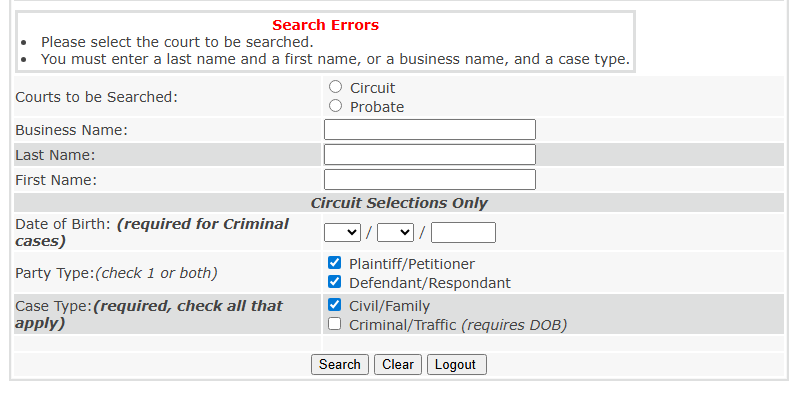
The system asks you to choose one court at a time:
Circuit Court – main trial court handling major criminal, civil, family and probate cases.
Probate Court – wills, estates, guardianships, and some family matters.
Select the division you want to search first.
Enter Your Search Information
You will see a form with fields such as:
Last Name or Business Name
- Enter the last name you want to search (minimum two letters).
- For business cases, enter the business name instead.
First Name
- This helps narrow results.
Date of Birth
- Required for Criminal and Traffic case searches. Without this, criminal/traffic results won’t show.
Party Type
- Choose whether the person is a Plaintiff or Defendant.
Case Type
- Check the type(s) of case you want to search:
- Civil/Family
- Criminal/Traffic
- Remember: Criminal/Traffic needs a date of birth.
Search by Case Number
If you already have a case number, there is a special link on the page:
- Click “Click here to search by case number” on the form.
- Enter the full case number exactly.
- Press Search.
Review Your Search Results
After pressing Search, the system shows a list of cases that match your criteria. Typical information includes:
• Case number
• Parties involved
• Case type (civil, criminal, family, etc.)
• Filing date
View Case Details
- Detailed case entries usually contain:
- Case status
- Next hearing date (if pending)
- Party names and roles
- Case history entries (docket events)
Structure of the Ingham County Judicial System
Ingham County judicial services operate as an integral part of Michigan’s statewide judiciary, providing local access to legal proceedings and civil matters. The county courts handle cases ranging from minor infractions to serious criminal and probate issues.
Ingham County’s courts are organized to fit within Michigan’s broader judicial framework. At the top level, the circuit courts manage major civil cases, felony criminal cases, and family law matters. District courts address misdemeanors, traffic violations, and small claims. The probate court oversees wills, estates, and guardianships, while specialty courts, such as drug or mental health courts, focus on specific types of cases with rehabilitative goals.
Court Divisions and Hierarchy
- Circuit Court: Handles serious civil and criminal cases, family law, and appeals from lower courts.
- District Court: Manages misdemeanors, traffic offenses, landlord-tenant disputes, and small claims.
- Probate Court: Supervises estates, guardianships, conservatorships, and adoptions.
- Specialty Courts: Focus on rehabilitation, including drug, mental health, and veterans’ courts.
County courts differ from federal courts in jurisdiction and authority. Federal courts address cases involving federal law, interstate matters, or constitutional issues, while county courts concentrate on local laws and community-level disputes. This distinction ensures cases are handled in the appropriate legal venue for efficiency and fairness.
Judicial Elections and Terms
Judges in Ingham County are elected by local voters and serve fixed terms depending on their court level. Circuit court judges typically serve six-year terms, while district and probate judges usually serve four-year terms. Elections ensure that judges remain accountable to the community while maintaining independence in decision-making.
By organizing courts into divisions and assigning specific case types, Ingham County judicial services maintain clarity and accessibility for residents. This structured hierarchy allows cases to move efficiently through the system, supporting the integrity of Michigan’s judiciary framework.
Key Takeaways:
- Circuit, district, probate, and specialty courts serve distinct functions.
- County courts focus on local legal matters, separate from federal jurisdiction.
- Judicial elections determine the tenure of judges at each level.
- The hierarchical system supports efficiency, fairness, and public access.
Circuit Court in Ingham County
The Ingham County Circuit Court serves as the county’s primary trial court for serious criminal and high-value civil cases. It operates as Michigan’s 30th Judicial Circuit and reviews appeals from local district courts.
The Ingham County Circuit Court plays a central role within the state trial court system. As the 30th Judicial Circuit, it holds broad authority over felony matters and major civil disputes. Judges in this court manage jury trials, bench trials, and pretrial proceedings that shape long-term legal outcomes across the county. Court operations follow Michigan court rules and statewide judicial standards.
Role of the 30th Judicial Circuit
The 30th Judicial Circuit oversees complex legal matters that exceed the limits of lower courts. It serves Lansing, East Lansing, and surrounding townships within Ingham County. Judges preside over trials, issue rulings on motions, and impose sentences in felony cases. The court also supervises specialty case tracks and post-judgment proceedings.
This court functions as a trial forum and a review body. Appeals from district courts often move to the circuit level for further review. These appeals focus on legal errors, procedural issues, or record-based challenges rather than new testimony.
Types of Cases Handled
The court manages a wide range of case types under Michigan law. Its jurisdiction includes both criminal and civil authority beyond district court limits.
Common case categories include:
- Felony criminal offenses, including sentencing and probation matters
- Civil litigation Michigan cases with claims over $25,000
- Domestic relations cases such as divorce, custody, and child support
- Juvenile delinquency and child protective proceedings
- Mental health commitment hearings
Appeals and Authority Thresholds
Appeals from district courts form a key part of circuit court work. These appeals review lower court records rather than retry facts. Judges assess whether the law was applied correctly.
A clear distinction exists between civil and criminal authority thresholds. District courts handle misdemeanors and lower-value civil claims. The Ingham County Circuit Court assumes control once felony jurisdiction applies or civil claim values exceed statutory limits. This division preserves efficiency and assigns complex cases to courts with broader judicial authority.
District Courts in Ingham County
Ingham County District Courts handle high-volume, day-to-day legal cases that affect residents and local businesses. These courts resolve matters quickly through limited jurisdiction and standardized court procedures.
The Ingham County District Courts form the first level of trial courts for most legal disputes. Each court serves a defined geographic area and manages cases that fall below circuit court limits. These courts focus on efficiency, early resolution, and public-facing legal services. Many residents interact with the district courts through traffic tickets, rental disputes, or misdemeanor charges.
Jurisdiction Across Ingham County District Courts
Ingham County operates three district courts, each with a separate service area and courthouse. Jurisdiction depends on where an incident occurred or where a party resides.
District court divisions include:
- 54A District Court, serving the City of Lansing
- 54B District Court, serving East Lansing, Meridian Township, and nearby areas
- 55th District Court, serving remaining townships and smaller municipalities
Types of Cases Commonly Heard
District courts manage legal issues tied to everyday life. Case volume remains high due to the frequency of minor offenses and civil disputes.
Typical case types include:
- Traffic violations, including speeding and license-related offenses
- Misdemeanor cases with penalties under one year
- Landlord tenant disputes such as evictions and rent claims
- Small claims and civil litigation Michigan cases under $25,000
- Preliminary hearings for felony cases before circuit court transfer
Role in Everyday Legal Matters
District courts serve as the public’s main entry point into the court system. Residents often appear without attorneys for civil infractions or housing disputes. Court staff provide procedural direction, scheduling support, and payment processing. These courts play a screening role for serious criminal matters. Felony cases begin with preliminary examinations at the district level before moving forward. This process protects due process and promotes efficient case flow.
Probate Court & Estate Matters
The Ingham County Probate Court oversees legal matters tied to estates, guardianships, and mental capacity cases. This court protects vulnerable parties and manages lawful property transfer after death.
The Ingham County Probate Court holds authority over wills and estates, trust administration, and protective proceedings. Its work centers on fairness, court supervision, and compliance with Michigan probate law. Judges review filings, approve actions, and resolve disputes tied to family and financial responsibility. Many cases involve long-term oversight rather than one-time hearings.
Probate Court Authority
Probate court authority covers estate administration and personal status cases. The court validates wills, appoints personal representatives, and monitors fiduciary conduct. In cases without a valid will, the court applies Michigan intestacy statutes to guide property transfer.
Key authority areas include:
- Wills and estates review and approval
- Trust supervision and accounting review
- Guardianship cases for minors and adults
- Competency hearings related to decision-making ability
Estate Distribution Process
The estate distribution process begins after a death filing. The court appoints a personal representative who gathers assets, pays lawful debts, and prepares accountings. Creditors receive notice, and disputes follow formal motion practice.
In practice, estates move through defined stages:
- Petition filing and appointment order
- Asset inventory and valuation
- Debt resolution and tax handling
- Final accounting and asset transfer
Guardianship and Conservatorship Roles
Guardianship cases focus on personal care decisions for minors or incapacitated adults. Conservatorship centers on financial management. The court appoints qualified parties and requires regular reports.
Competency hearings assess decision-making capacity through medical evidence and testimony. Judges balance personal rights with protection needs. Through ongoing supervision, the Ingham County Probate Court promotes stability, accountability, and lawful care for those unable to manage affairs independently.
Family Division of Ingham County Court
The Ingham County Family Court handles legal matters that directly impact families, including divorce, child custody, and support disputes. This court ensures that domestic relations issues are resolved fairly while prioritizing the well-being of children and families.
Domestic Relations Cases: Divorce, Custody, and Support
The Family Division manages a wide range of domestic relations cases. Divorce proceedings involve equitable distribution of property, alimony considerations, and parental responsibilities. Child custody disputes are resolved with the child’s best interests in mind, considering factors such as parental involvement, stability, and safety. Child support cases ensure that financial responsibilities are fairly assigned and enforced.
Adoption and Name Changes
Beyond divorce and custody, the court has authority over adoption cases. Prospective parents work with the court to complete legal adoption processes, ensuring compliance with state laws and safeguarding the rights of children. Additionally, the court handles legal name changes, allowing individuals, including minors, to update their names through a formal judicial process.
Family-Focused Judicial Processes
The Family Division emphasizes family-focused judicial processes, incorporating procedures designed to reduce conflict and promote cooperation between parties. This includes mediation services and parenting time agreements that aim to minimize disruption to children’s lives. The court often collaborates with social workers and family service agencies to provide additional support when necessary.
Key Features of Ingham County Family Court:
- Handles divorce, custody, and child support cases efficiently.
- Oversees adoptions and legal name changes.
- Promotes mediation and family-focused solutions to reduce conflict.
- Works with supportive services to protect the welfare of children.
Juvenile Court Services
The Ingham County Juvenile Court focuses on legal matters involving minors, addressing both delinquency and child welfare issues. It aims to provide protection, rehabilitation, and guidance for youth while balancing accountability with support.
Delinquency and Dependency Cases
Ingham County Juvenile Court handles two primary types of cases: delinquency and dependency. Delinquency cases involve minors accused of violating the law, ranging from misdemeanors to more serious offenses. The court works to hold youth accountable while offering programs designed to prevent repeat offenses. Dependency cases focus on children who require protection due to abuse, neglect, or unsafe living conditions. Social services and court-appointed advocates assist in ensuring the child’s welfare is prioritized.
Emancipation Process
The court also oversees the emancipation of minors, allowing eligible youth to gain legal independence from their parents or guardians. This process involves reviewing the minor’s ability to manage personal, financial, and educational responsibilities. Emancipation is granted only when the court determines it serves the minor’s best interests.
Protective Role of Juvenile Court
A central mission of the Ingham County Juvenile Court is protection and rehabilitation. Youth court services include counseling, mentorship programs, and community-based interventions aimed at supporting positive development. By balancing accountability with care, the court helps minors make constructive choices while ensuring their safety and well-being.
Key Functions of Ingham County Juvenile Court:
- Handles delinquency and dependency cases.
- Manages the legal process for minor emancipation.
- Provides protective and rehabilitative services for youth.
- Collaborates with social workers, schools, and community programs.
Specialty Courts in Ingham County
Ingham County specialty courts provide structured court programs that focus on treatment and accountability rather than punishment alone. These courts serve eligible participants through close supervision, therapy, and coordinated public services.
Ingham County specialty courts address specific needs that traditional case processing may not resolve. These programs focus on behavior change, community safety, and reduced repeat offenses. Each court follows a problem-solving model that blends judicial oversight with treatment services. Participation requires meeting eligibility rules set by the court and partner agencies. Core features of Ingham County specialty courts include regular court reviews, clear progress benchmarks, and coordinated support services. Program length varies by court type and participant progress. State and federal partners support funding, treatment standards, and data reporting.
Veterans Treatment Court
The Veterans Treatment Court serves military veterans charged with certain non-violent offenses. Eligibility often depends on service history, discharge status, and a diagnosed condition linked to service, such as PTSD or substance use disorder.
This court uses a structured plan that combines treatment with close court supervision. Participants attend frequent status hearings and work with a veteran mentor who has lived military experience. Program length often ranges from 12 to 24 months, based on progress and compliance.
Key program elements include:
- Behavioral health treatment and substance counseling
- Regular drug testing and court reviews
- Peer mentoring from trained veteran volunteers
- Clear incentives for progress and sanctions for noncompliance
Drug Court Programs
Drug court programs in Ingham County focus on adults facing charges tied to substance use. Eligibility often depends on offense type, prior record, and clinical screening results. Violent offenses usually do not qualify.
These programs follow a phased structure. Early phases emphasize stabilization and treatment. Later phases focus on employment, education, and long-term recovery planning. Total duration commonly spans 12 to 18 months.
Typical drug court structure includes:
- Clinical assessment and treatment placement
- Frequent testing and judicial check-ins
- Group or individual counseling sessions
- Gradual reduction of court supervision
Role of the Ingham County Clerk
The Ingham County Clerk of Court manages court records, jury operations, and official filings for county courts. This office supports judicial proceedings through accurate documentation and public-facing court services.
The Ingham County Clerk of Court serves as the administrative backbone of the local court system. This role centers on record accuracy, procedural integrity, and timely case processing. Clerks work behind the scenes to keep court operations organized and compliant with Michigan court rules. Daily tasks involve coordination with judges, court staff, attorneys, and the public.
Clerk’s Core Responsibilities
The clerk’s office handles a wide range of court-related duties that support legal proceedings from start to finish. These responsibilities require strict attention to detail and adherence to statutory timelines.
Primary responsibilities include:
- Court records management for filings, orders, and judgments
- Processing legal filings for civil and criminal cases
- Maintaining official court dockets and calendars
- Managing jury administration, including summons and juror records
- Collecting court fees, fines, and bond payments
Relationship With the Circuit Court
The clerk works closely with the Ingham County Circuit Court, supporting judges assigned to the 30th Judicial Circuit. This relationship involves preparing case files, recording court actions, and entering final judgments. During trials and hearings, clerks document proceedings and manage exhibits.
Clerks support appellate preparation by certifying records when cases move to higher courts. This coordination helps maintain consistent case flow and procedural compliance.
Public Records and Filings Oversight
Public records oversight remains a central duty of the clerk’s office. The clerk safeguards filed documents and maintains official copies of court actions. Filing systems follow state retention schedules and confidentiality rules.
Through structured records control and jury coordination, the Ingham County Clerk of Court supports fairness, accountability, and orderly court administration across the county.
Magistrates, Referees & Judicial Officers
Ingham County judicial officers support judges by handling focused hearings and procedural matters. Their work speeds case flow while preserving fairness and due process.
Ingham County judicial officers include magistrates, court referees, and judicial hearing officers. These officials operate under authority granted by Michigan law and local court rules. Appointment occurs through statutory processes, often by the chief judge, with required legal training and experience. Their decisions carry legal effect within defined limits and remain subject to judicial review.
Authority and Appointment
Magistrate authority covers specific case types and actions assigned by statute or court order. Referees receive delegated authority to hear matters and issue recommendations or orders, depending on the case. Judicial hearing officers handle targeted functions, often in high-volume settings.
Common appointment features include:
- Formal designation by the court
- Defined scope of authority and term
- Ongoing oversight by elected judges
Types of Hearings Handled
These officers preside over hearings that benefit from focused attention and consistent scheduling. Their assignments vary by court division and workload needs.
Typical hearings include:
- Arraignments and bond reviews
- Preliminary motions and scheduling conferences
- Family and juvenile matters before a referee
- Traffic and ordinance violations
- Post-judgment compliance reviews
Streamlining Court Operations
Judicial hearing officers play a direct role in efficient court management. By resolving routine matters promptly, they reduce delays for trials and complex hearings. This division of labor improves calendar control and shortens wait times. As a result, judges focus on cases requiring full judicial authority, and court users experience clearer timelines and steadier progress.
How the Ingham County Court System Serves the Public
Ingham County judicial services support fair case handling, open court operations, and community trust. The court system works to balance legal accountability with clear procedures for residents and case participants.
The Ingham County judicial services framework focuses on openness, responsibility, and equal treatment under the law. Courts operate with publicly available schedules, filings, and hearings, subject to privacy rules. This approach allows community members to observe court activity and stay informed about legal proceedings. Court operations follow state rules that promote consistent outcomes and predictable processes.
Public Entry and Court Philosophy
Public entry into the court system reflects a commitment to visibility and civic confidence. Courtrooms remain open for observation during most proceedings. Written records, calendars, and rulings form part of the public record unless sealed by law.
Key elements of this philosophy include:
- Open courtrooms for most hearings
- Published dockets and case activity
- Clear filing procedures and timelines
- Language support and accommodation services
Legal Accountability and Transparency
Legal accountability guides every court action. Judges, clerks, and judicial officers follow ethical standards and procedural rules. Decisions rely on statutes, case law, and the official record. This structure supports legal transparency and limits arbitrary outcomes.
Court performance also remains subject to oversight. Higher courts review rulings through appeals. Audits and reporting requirements monitor case handling and financial activity. As a result, public confidence grows through consistent oversight and documented decision-making.
Fairness and Due Process Principles
Fairness and due process shape all judicial activity. Parties receive notice, hearing opportunities, and the right to present evidence. Neutral decision-makers evaluate facts and apply the law evenly.
Court assistance services support this process by offering forms, scheduling help, and procedural explanations. Through these combined efforts, Ingham County judicial services promote orderly justice, public trust, and equal treatment for all participants.
Historical Background of Ingham County Courts
The Ingham County court system developed alongside Michigan’s early settlement and state growth. Its structure reflects more than a century of legal change, civic planning, and regional leadership.
The Ingham County court system traces its judicial history to the mid-1800s, soon after the county’s formation in 1838. Early courts met in modest buildings and private spaces, serving a small but growing population. Judges handled land disputes, probate matters, and early criminal cases tied to settlement patterns. These early proceedings laid the foundation for formal court authority in central Michigan.
Early Court Establishment in the 1800s
During the 19th century, Ingham County courts followed territorial and early state laws. Mason served as the original county seat, making it the first center of judicial operations. Courthouse development began with simple wooden structures, later replaced by brick buildings as case volume increased. Records from this period show a steady rise in civil filings tied to farming, trade, and property ownership. Judicial officers traveled widely, holding sessions on fixed schedules. This system supported order during a time of rapid population growth.
Courthouse Development and Legal Growth
- As Michigan law expanded, so did courthouse design and function. New facilities added dedicated courtrooms, clerk offices, and record storage. These changes improved court efficiency and record preservation. By the early 20th century, courts followed standardized procedures aligned with statewide reforms.
- Lansing’s rise as the state capital shifted judicial activity. New courts opened closer to population centers, reflecting urban growth and administrative demand.
Mason and Lansing in Judicial Operations
Mason retained long-term importance through historic courthouses and probate functions. Lansing emerged as the primary hub for circuit and district court activity. This balance allowed courts to serve both rural and urban communities.
Influence on the Modern Court System
Historical development shaped today’s court structure through layered jurisdiction and professional administration. Clear divisions between trial courts reflect lessons learned over decades. The present-day Ingham County court system carries forward these principles, combining historical roots with modern judicial practice.
Ingham County Court Locations
Ingham County courts Michigan serve residents and businesses through several courthouses across the county, each with specific jurisdiction areas. Knowing where each court sits helps people file cases, attend hearings, and access legal services.
The Ingham County courts Michigan system includes state trial courts (circuit, district, probate/family) located in Mason, Lansing, and East Lansing. Federal courts have a presence nearby for cases under federal law. Each court’s jurisdiction covers defined areas or types of cases.
Circuit Court Facilities
The 30th Judicial Circuit Court handles felony criminal matters, major civil litigation, family law, and appeals from district courts. Circuit jurisdiction covers all of Ingham County. Its main facilities are:
- 30th Judicial Circuit Court – 303 W Kalamazoo St, Lansing, MI 48933 (Veterans Memorial Courthouse)
- Ingham County Court House – 315 S Jefferson St, Mason, MI 48854 (historic courthouse)
District Court Locations
District courts hear lower-level criminal, traffic, landlord-tenant, and small civil cases. Jurisdiction depends on where a case arose or where the person lives:
- Lansing 54 A District Court – 124 W Michigan Ave, Lansing, MI 48933 (serves Lansing residents)
- 54‑B District Court – 101 Linden St, East Lansing, MI 48823 (serves East Lansing residents)
- 55th District Court – 700 Buhl St, Mason, MI 48854 (serves the rest of Ingham County)
Probate and Family Court Locations
Probate and family matters — such as wills and estates, guardianships, conservatorships, and personal status cases — are handled in Lansing:
- Probate Court‑Probate Division – Veterans Memorial Courthouse, 313 W Kalamazoo St, Lansing, MI 48933
Frequently Asked Questions
These FAQs answer common questions about court procedures, jurisdiction, and case handling in Ingham County, helping residents and legal professionals access judicial services efficiently.
Which court handles my case?
The court that hears a case depends on its type, severity, and location. District courts handle misdemeanors, traffic violations, landlord-tenant disputes, and civil claims under $25,000. Circuit courts manage felony cases, high-value civil litigation over $25,000, family law, and appeals from district courts. Probate courts deal with wills, estates, guardianships, and conservatorships.
What is the difference between circuit and district court?
Circuit courts have broader jurisdiction and handle complex cases, including felony criminal trials, major civil disputes, and family law matters. District courts deal with less serious criminal offenses, small civil claims, and preliminary hearings. Circuit courts often conduct jury trials, while district courts focus on faster case resolution.
How is jurisdiction determined?
Jurisdiction is based on case type, the value or severity of the matter, the location of the incident, and applicable laws. State courts handle most local disputes, while federal courts address federal law violations or disputes between parties from different states. Filing in the correct court ensures timely and proper case processing.
What specialty courts are available?
Ingham County operates several specialty courts to address specific needs through treatment and supervision. Examples include Veterans Treatment Court, Drug Court Programs, Mental Health Court, and Family Treatment Court. These courts focus on rehabilitation and reducing repeat offenses rather than only punishment.
What additional services do the courts provide?
Courts offer public access to records, jury administration, and procedural support. Clerks maintain filings, schedule hearings, and ensure transparency while protecting sensitive information. These services uphold fairness, accountability, and community trust in the judicial system.